
Last updated October 16, 2026
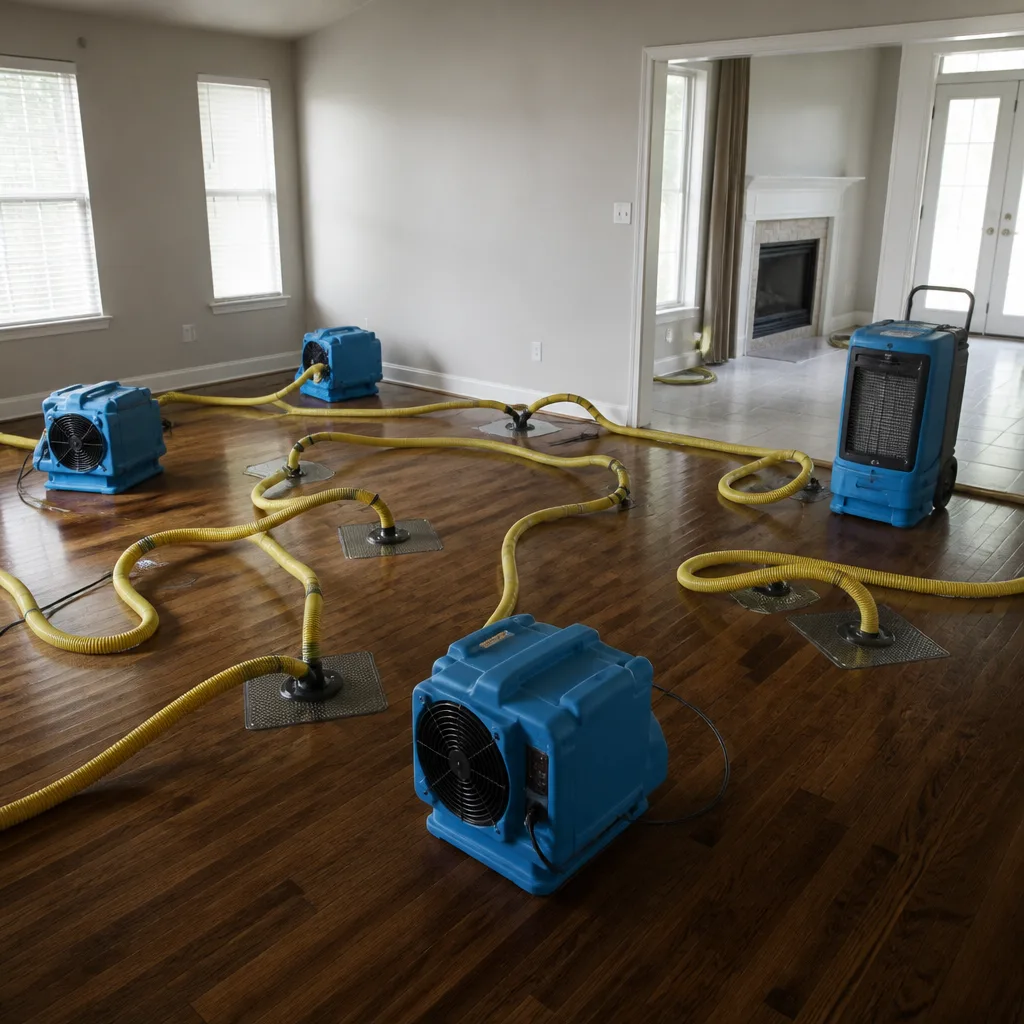 Water damage drying
 Fire & smoke cleanup
 Mold remediation
 Storm response
 Sewage cleanup
 Reconstruction
Free visual inspection and a written scope of work before any mitigation begins - photos, moisture readings, and drying logs go in your claim file
The scope we write is the scope we bill. Anything new gets shown to you, in writing, before we touch it.
Get your free estimateDamage Restoration Cost Breakdown: The Austin Homeowner’s Reference for 2026
Here’s the thing most Austin homeowners don’t realize until they’re standing in two inches of water: the final bill on a restoration job has very little to do with how bad the damage looks. It’s built on a pricing formula that restoration contractors and insurance adjusters both use, and once you understand that formula, you can spot inflated estimates, question vague line items, and know whether a quote is fair before you sign anything. The single biggest cost variable in Austin water damage jobs isn’t the water itself. It’s whether your drywall gets classified as “affected” or “Category 3 contaminated,” a distinction that can triple the per-square-foot removal cost and is sometimes applied more broadly than the damage actually warrants. This guide breaks down every line item, every classification, and every market force shaping restoration pricing in Austin for 2026, and you can find more guides & resources on our blog.
We’re Wendell Restoration Austin, and we’ve been doing this work here since 2006. We put prices in writing before work starts, and we’re going to show you exactly what that written price should contain.
Restoration work we handle
Quick Answer
Water damage restoration in Austin typically costs between $1,200 and $6,500 for most residential jobs in 2026, with an average around $3,400. Mold remediation runs $1,500 to $6,000 depending on affected square footage and material classification. The final number is driven by three factors: damage category (clean water vs. contaminated), affected square footage, and what materials can be dried in place versus what has to be removed and rebuilt.
Table of Contents
- The Pricing Formula: Why Austin Restoration Costs What It Costs
- Line-by-Line Cost Anatomy for 2026
- How Xactimate Works and Why You Should Care
- Legitimate Cost Escalation vs. Scope Creep
- Austin Labor Market Reality: Why Rates Are Up 18 – 22%
- What a Written Price Actually Looks Like
- Insurance and Restoration Pricing in Austin
- Common Mistakes to Avoid
- When to Call a Professional
- Frequently Asked Questions
- The Bottom Line
The Pricing Formula: Why Austin Restoration Costs What It Costs
Restoration pricing is not a bid. It’s a calculation. Contractors in Austin who do this work properly build estimates from the same three inputs: damage category, affected square footage, and material classification. Change any one of those inputs and the number moves, sometimes dramatically.
Damage category comes from the IICRC S500 standard, the water damage restoration industry’s reference document. Category 1 is clean water from a supply line or a sink overflow. Category 2 is “gray” water with some contamination, like a washing machine discharge or a sump pump failure. Category 3 is “black” water carrying sewage, floodwater, or anything that’s been sitting long enough to grow bacteria. Each step up in category means more protective equipment for the crew, more aggressive antimicrobial treatment, and more material removal rather than drying in place. In Austin, where summer temperatures push standing water into bacterial growth territory within 48 hours, Category 1 jobs that sit unaddressed over a weekend frequently get reclassified to Category 2 or 3 by the time a crew actually starts work.
Affected square footage is the second multiplier. Restoration pricing works on a per-square-foot basis for extraction, drying, and antimicrobial application. A 10-by-10 bedroom with water across half the floor is 50 affected square feet, not 100. Austin homes built on slab foundations, which is most of them, tend to have water spread horizontally across flooring before it wicks upward into drywall. Homes with pier and beam foundations, common in older neighborhoods like Hyde Park and Travis Heights, often see water drop through the floor system into the crawlspace, which adds a separate line item for subfloor drying and encapsulation.
Material classification is where costs really diverge. Drywall is classified by drying potential. Wet drywall with no visible contamination can sometimes be saved with the right equipment and enough time. Drywall that’s been saturated to the point of crumbling, or that’s been exposed to gray or black water, comes out. In Austin’s humid climate, especially from May through September, the drying window is shorter than it is in drier parts of Texas. Materials that would dry out in El Paso sometimes have to be cut out here because the ambient humidity keeps the drying process from getting ahead of the mold growth curve.
Understanding these three inputs means you can look at any estimate and ask the right questions: What category is the water? How many square feet are actually affected? Which materials are being removed versus dried? The answers should be specific, measured, and consistent across the estimate. If they’re vague, that’s your first red flag.
Line-by-Line Cost Anatomy for 2026
Here’s what a complete water damage restoration estimate in Austin should contain in 2026, with realistic market rate ranges for each line item. These are the numbers we see on actual jobs in this city, from Round Rock down to Buda.
- Emergency water extraction: $350 to $900 for a typical single-room job using a truck-mounted or portable extraction unit. This covers standing water removal, not drying.
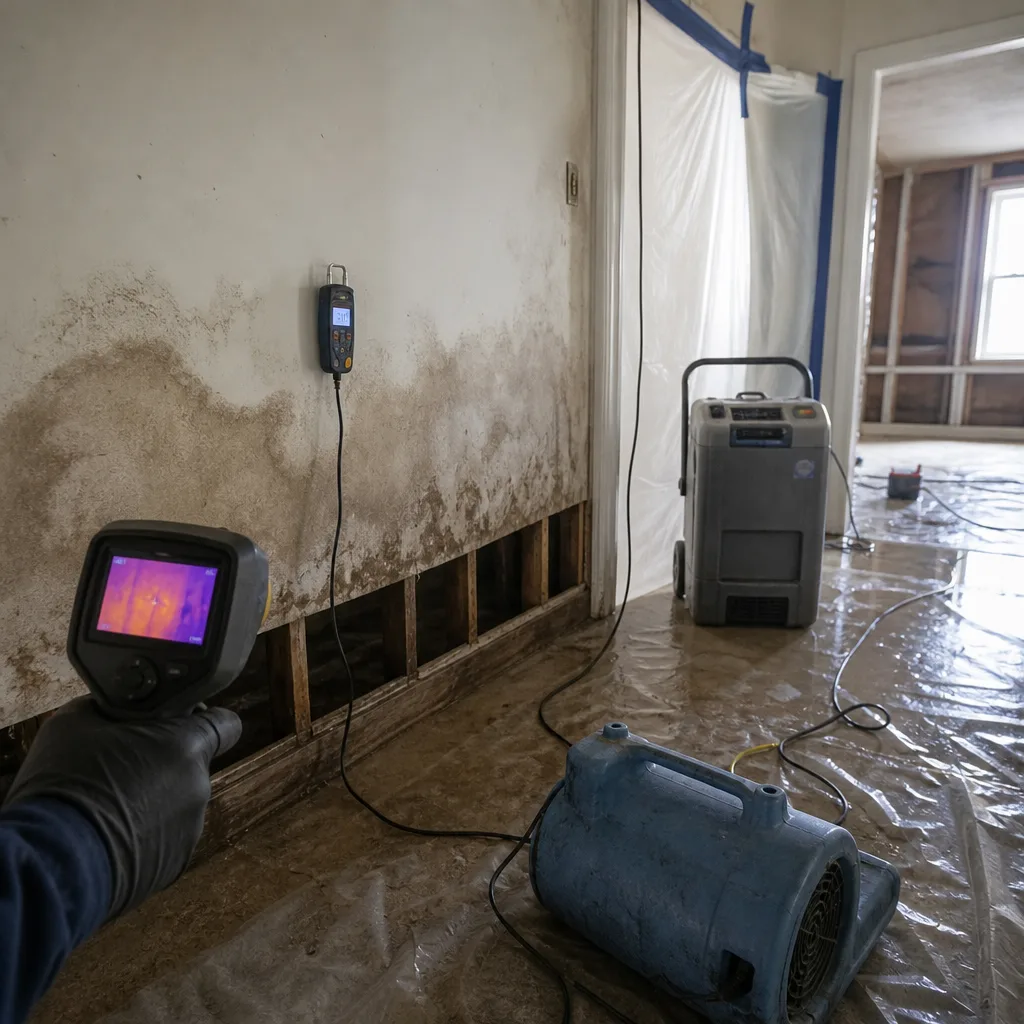
- Moisture mapping and assessment: $150 to $400. A technician uses moisture meters and thermal imaging to document exactly where water has traveled. This step is non-negotiable for a defensible claim.
- Dehumidifier rental and operation: $45 to $85 per dehumidifier per day. A typical 300-square-foot water loss needs one large dehumidifier running 3 to 5 days.
- Air mover rental and operation: $25 to $40 per air mover per day. Most rooms need 3 to 6 air movers depending on affected square footage.
- Antimicrobial and biocide application: $0.35 to $0.75 per square foot of affected material. Applied to framing, subfloor, and remaining surfaces after contaminated materials are removed.
- Controlled demolition and debris removal: $3 to $7 per square foot for drywall removal, $4 to $9 per square foot for flooring removal, including haul-away. Category 3 jobs land at the top of these ranges because of containment and disposal requirements.
- Psychrometric drying management: $45 to $65 per day. This is the daily monitoring service where a technician tracks the air’s moisture level and the materials’ moisture content to confirm everything is actually drying, not just surface-dry.
- Rebuild and reconstruction: $8 to $18 per square foot for drywall replacement, texture, and paint, depending on finish level. Flooring replacement runs $4 to $12 per square foot depending on material.
These are Austin market rates for 2026, and they’ve moved. The cost of a full restoration including rebuild on a 300-square-foot Category 2 loss now runs between $4,000 and $8,500. The same job in 2022 would have come in closer to $3,200 to $6,800. We’ll get to why in the labor section below.
How Xactimate Works and Why You Should Care
If you file an insurance claim for water damage in Austin, your adjuster will almost certainly price the loss using Xactimate, the estimation software used by most insurers in the United States. It’s a database of line-item costs, updated regularly, with region-specific pricing for labor and materials. When your adjuster says a job “should cost” a certain amount, they’re pulling from Xactimate.
Here’s why this matters for you. A restoration contractor who writes estimates in Xactimate is speaking the same language as your insurer. The line items match. The codes match. The pricing logic matches. Claims get approved faster, disputes get resolved faster, and you spend less time as the messenger between your contractor and your insurance company.
More importantly, Xactimate gives you a reference point. If your contractor’s estimate includes a line item for “WTR DRY-A” (air mover, per day) at $85 per unit, and Xactimate’s Austin market pricing for that same line is $40, you can ask why. Sometimes there are legitimate reasons. A third-floor unit with no elevator access costs more to move equipment into. A Category 3 job requires HEPA-filtered air scrubbers that don’t show up on a clean water loss. But the conversation should be specific and technical, not hand-waved.
You can also run the numbers the other direction. If your adjuster pushes back on a line item your contractor says is standard, ask for the Xactimate line code. A legitimate restoration estimate has them. A vague one does not.
One more thing about Xactimate that most homeowners never hear: it’s not a fixed price list. It’s a baseline. Contractors are free to add percentages for overhead and profit, which is standard, and for access issues, complexity, or after-hours work. The key is that those add-ons should be line items on the estimate, not invisible padding.
Legitimate Cost Escalation vs. Scope Creep
Every restoration contractor in Austin has started a job expecting a two-day dry-out and found something worse behind the drywall-learn to spot these issues early with our Damage Restoration Warning Signs: A Austin Homeowner’s Reference Guide. That’s not dishonesty. It’s the nature of water, which travels downward and sideways into spaces you can’t see until you open things up.
Legitimate mid-job cost increases happen for these reasons:
- Category reclassification. Water that looked clean gets tested, or simply sits long enough, and gets reclassified from Category 1 to Category 2 or 3. This changes what must be removed and what protective measures are required.
- Hidden secondary damage. Water that wicked up inside wall cavities, under cabinets, or into subfloor systems that weren’t visible during the initial assessment.
- Structural discoveries. Finding pre-existing issues in Austin’s older housing stock, like a pier and beam home in the Crestview area with floor joists that were already compromised before the water event.
- Drying timeline extensions. Austin’s humidity in summer months can add days to a drying timeline, which means more equipment days at the per-day rates listed above.
Illegitimate escalation looks different. It’s the contractor who adds square footage without re-measuring. It’s the drying equipment that keeps running past the point where moisture readings justify it. It’s the “we’ll handle it and bill you later” line that turns into a number you never agreed to.
The line between legitimate and illegitimate is a written change order. If something gets reclassified, the contractor should document it, explain it, and get your sign-off before the work proceeds. Wendell Restoration Austin has done it this way since 2006, and it’s part of the Water Damage Restoration in Austin process we follow on every job. No change order, no surprise bill.
Austin Labor Market Reality: Why Rates Are Up 18 – 22%
Restoration labor in Austin is not cheap, and it’s not getting cheaper. Skilled restoration technicians in this market are running 18 to 22 percent above 2022 compensation levels, and those costs flow directly into every estimate you’ll see in 2026.
The reasons are specific to this city. Austin’s construction boom, driven by residential growth in the suburbs and commercial development along the I-35 corridor, has pulled skilled tradespeople toward new construction. A drywall finisher or flooring installer can make steady money on new builds without ever dealing with Category 3 sewage water at 3 a.m. Restoration companies have to pay more to keep people who are willing to do this work, and those people have more options than they did a decade ago.
There’s a second force at play. Austin’s housing stock is aging, and a lot of it was built fast. Homes put up during the growth spurts of the 1990s and early 2000s, particularly in the northern suburbs and out toward Pflugerville, are now hitting the age where supply lines, water heaters, and plumbing systems start failing. The volume of water damage calls has risen accordingly, and the labor pool hasn’t kept pace.
What this means for your rebuild timeline is important. The drying and mitigation phase, the first few days, is handled by restoration technicians and tends to move fast. The rebuild phase, the part where drywall goes back up and flooring goes back down, depends on subcontractors who are booked out. In 2026, expect a gap between mitigation and rebuild on larger jobs. A full repair that took three weeks in 2022 might take four to five now. Plan accordingly, and ask your contractor about their sub availability before you sign.
What a Written Price Actually Looks Like
We’ve spent a lot of time talking about what should be in an estimate, so let’s show you what a good one looks like. This is the structure we use at Wendell Restoration Austin on every job. If you’re comparing contractors, compare against this standard.
A transparent restoration quote contains:
- Damage category and classification. Stated explicitly: “Category 2 water loss, 240 affected square feet.”
- Line-item extraction cost. One number for the extraction visit, including equipment and labor.
- Equipment schedule. How many dehumidifiers, how many air movers, and for how many days, each at the Austin market per-day rate.
- Drying management. The daily monitoring service with moisture readings documented in writing.
- Antimicrobial application. Square footage treated and the specific product or process used.
- Demolition scope. Exact materials to be removed, in square feet, with disposal included.
- Rebuild scope. Exact materials to be replaced, with finish levels specified.
- Total price. One number, in writing, before work starts.
Our Wendell Restoration Austin home process includes a digital invoice texted to your phone after the work is done, so the number on the estimate is the number on the invoice. If something changes mid-job, you get a written change order before the new work starts, not after. That’s the whole model.
Blake Sorensen, who runs Wendell Restoration Austin, has a rule about this: if a homeowner asks what something costs and the answer starts with “well, it depends,” something’s wrong. It might depend on specifics, but those specifics should be listed and priced. Vague answers before work starts become expensive answers after work finishes.
Insurance and Restoration Pricing in Austin
Most Austin water damage jobs touch an insurance claim at some point, and that’s where pricing gets complicated for homeowners. Here’s the short version: your insurer prices the loss using Xactimate, your contractor prices the loss using their actual costs plus margin, and the gap between those two numbers is where disputes happen.
Some Austin restoration contractors will tell you they “work with all insurance companies.” What that usually means is they accept the insurer’s pricing and adjust their scope to fit it. That can work fine on a simple Category 1 loss. On a Category 3 sewage backup or a job with extensive rebuild work, it often means corners get cut or you get surprised with a supplemental bill.
The better approach, and the one we take at Wendell, is to write an honest scope first, price it fairly, and let the insurance conversation happen around that document. We provide photo documentation of everything, which helps with adjuster communication. When the adjuster has clear before-and-after photos and a line-itemed Xactimate estimate, the process moves faster. We’ll coordinate directly with your adjuster so you’re not the one translating between two parties who speak different pricing languages.
One Austin-specific note: if your home is in a flood zone near one of our creeks, check whether your damage is covered by your homeowners policy or whether it falls under a separate flood policy. A plumbing leak inside the house is usually covered by standard homeowners insurance. Water that comes in through the foundation from rising creek water is typically not. These are very different claims, and Water Damage Repair in Austin after a flood event follows a different process than a supply line break.
Common Mistakes to Avoid
- Signing a work authorization without reading it. Some Austin restoration contracts include language allowing the contractor to authorize additional work without re-approval. Read it, and if you don’t like a clause, ask for it to be changed. A legitimate contractor will change it.
- Delaying a Category 1 response. Clean water becomes gray water in 24 to 48 hours in Austin’s climate. A Saturday supply line break that waits until Monday afternoon can double your mitigation cost through reclassification alone.
- Paying a large deposit before work starts. Established Austin restoration companies don’t need 50 percent upfront on an insurance-covered loss. A nominal deposit on a non-insurance job is normal. Half the estimate before a truck shows up is not.
- Accepting an estimate without a moisture map. If the contractor can’t show you where the water is and how far it traveled, they guessed. Guessed square footage becomes wrong square footage, and wrong square footage becomes either overbilling or a job that re-molds in six months.
- Choosing a contractor solely on price. The cheapest Austin restoration quote often skips the drying management line item entirely. That’s the part that makes sure your walls don’t grow mold after the surface looks dry. Skipping it saves $300 now and costs $5,000 in Mold Remediation in Austin later.
- Not confirming what “done” means. Does the estimate include texture matching on replaced drywall? Paint, or just primer? Baseboards re-installed or just delivered? These are line items. Ask.
- Waiting on the insurance company before calling a contractor. Austin restoration companies respond immediately and document everything. Waiting for an adjuster to call back while water sits in your house is the most expensive decision you can make.
When to Call a Professional
Any water damage that extends beyond what you can mop up with towels in an hour is worth a professional assessment. Standing water that’s been there more than 24 hours, water that originated from sewage or outside your home, water that’s soaked into drywall or under flooring, or any water event where you can see visible mold growth all require trained intervention. Water behind walls doesn’t dry itself in Austin’s humidity, no matter how many fans you point at it. Wendell Restoration Austin offers free estimates in Austin. Call (325) 237-2088 and a live person answers, 24/7, not a voicemail.
Frequently Asked Questions
Most residential water damage restoration jobs in Austin cost between $1,200 and $6,500 in 2026, with the average around $3,400. The range depends on damage category, affected square footage, and whether materials can be dried in place or need removal and replacement. Call (325) 237-2088 for a written estimate specific to your loss.
Standard homeowners insurance covers sudden and accidental water damage from sources like burst pipes, supply line failures, and appliance overflows, but does not cover flooding from rising creek or storm water without a separate flood policy. Coverage also depends on the cause being sudden rather than gradual. Photo documentation and a line-itemed estimate help your claim process move faster.
Mitigation and drying typically take 3 to 5 days for a standard residential water loss. Rebuild work after drying adds 1 to 3 weeks depending on scope and subcontractor availability, which is tighter in Austin’s 2026 construction market than it was a few years ago. Austin’s summer humidity can extend drying timelines by a day or two compared to the same job in a drier climate.
Water damage restoration addresses the water event itself: extraction, drying, and repair of affected materials. Mold remediation addresses mold growth that has already occurred, using containment, specialized cleaning, and removal of colonized materials. A properly dried water loss should not develop mold, but water that sits unaddressed in Austin’s climate will almost always produce growth within several days.
For very small, contained water spills on hard surfaces, maybe. For water that has wicked into drywall, under baseboards, or into flooring, no. Residential fans and store-bought dehumidifiers don’t move enough air or pull enough moisture to prevent mold growth inside wall cavities. The equipment used by restoration companies moves air at rates measured in cubic feet per minute, not desk-fan settings.
Water travels inside wall cavities and under flooring in ways that aren’t visible until materials are opened up. If water has wicked further than the initial assessment showed, or if the water is reclassified to a higher contamination category, the scope legitimately changes. A reputable contractor will document the change, explain the reason, and get your written approval before proceeding. Scope increases should never be a surprise.
The Bottom Line
Austin restoration pricing in 2026 follows a formula: damage category times affected square footage times material classification, adjusted by a labor market running 18 to 22 percent above 2022 levels. Understand that formula and you can read any estimate like a pro. Demand line items, written change orders, and photo documentation. Know the difference between a contractor who prices transparently and one who prices vaguely. Make sure you also understand local Damage Restoration Permits, Codes & Inspections in TX: What You Need to Know. And if you want the number in writing before any work starts, with a live person answering the phone every time you call, that’s exactly what Wendell Restoration Austin does. Call (325) 237-2088 for a free estimate.
Written by Blake Sorensen, Owner at Wendell Restoration Austin, serving Austin since 2006.
See the difference
 Before
 After
After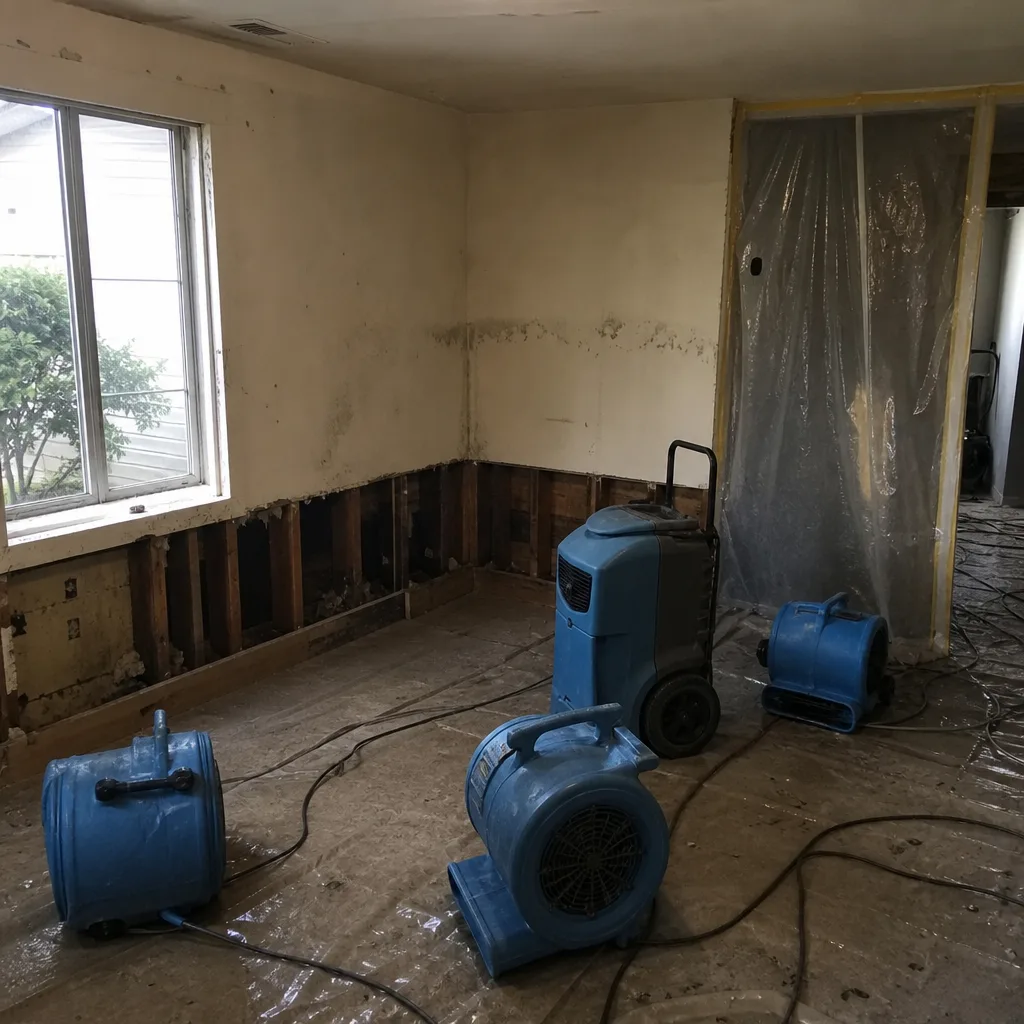 Before
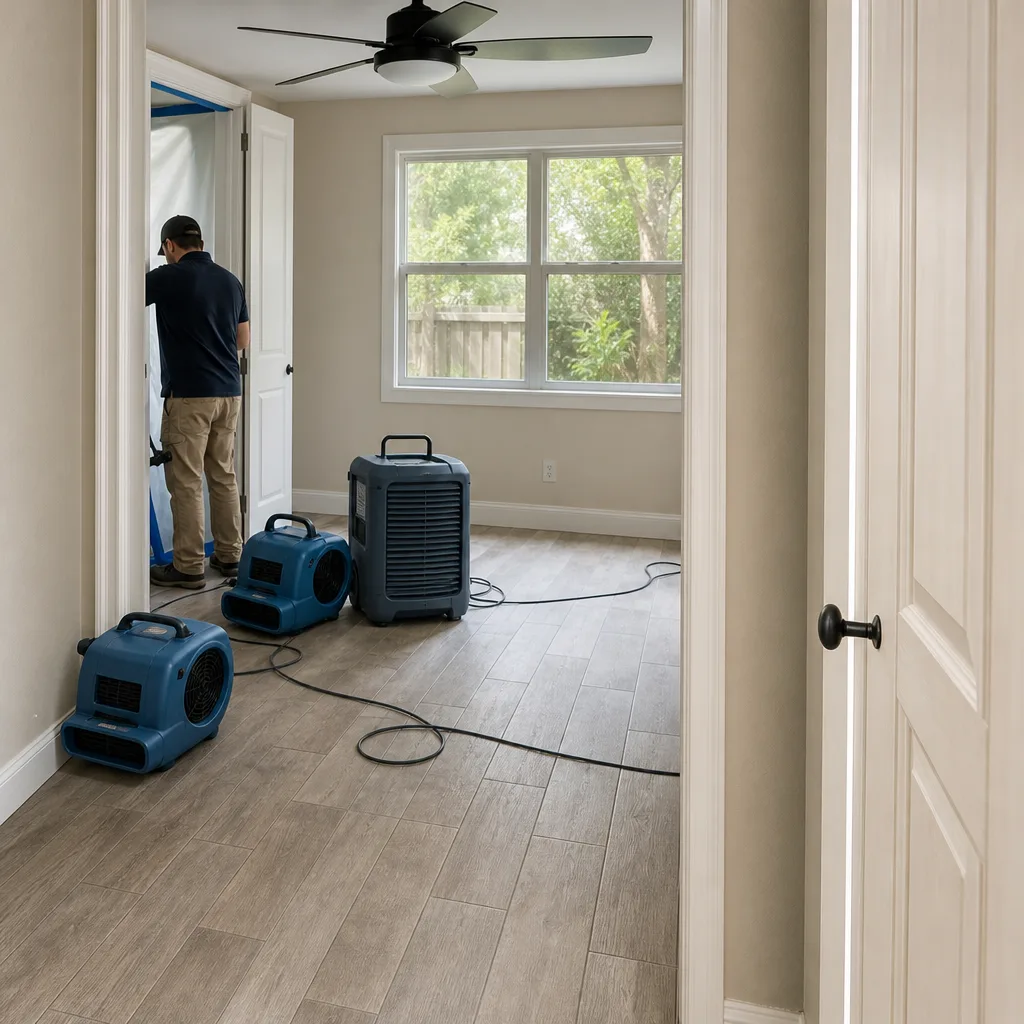 After
After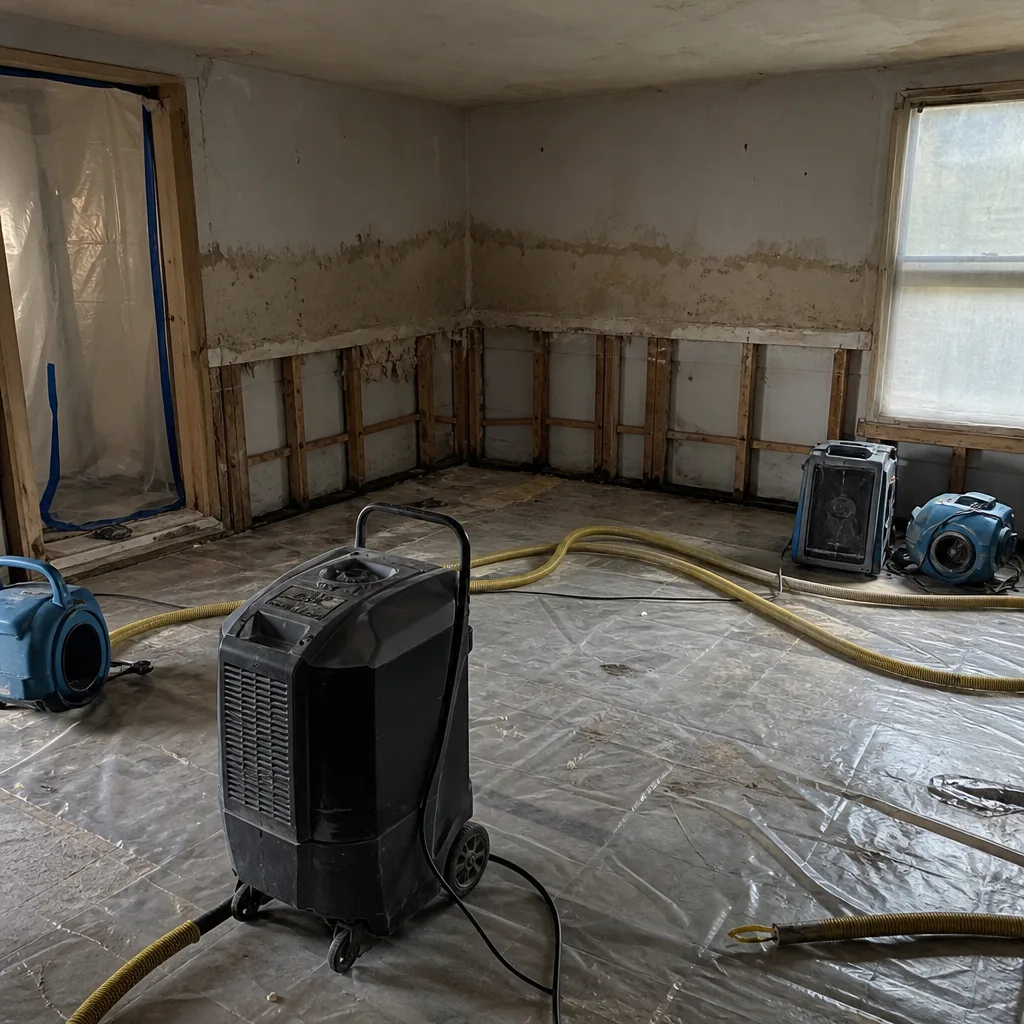 Before
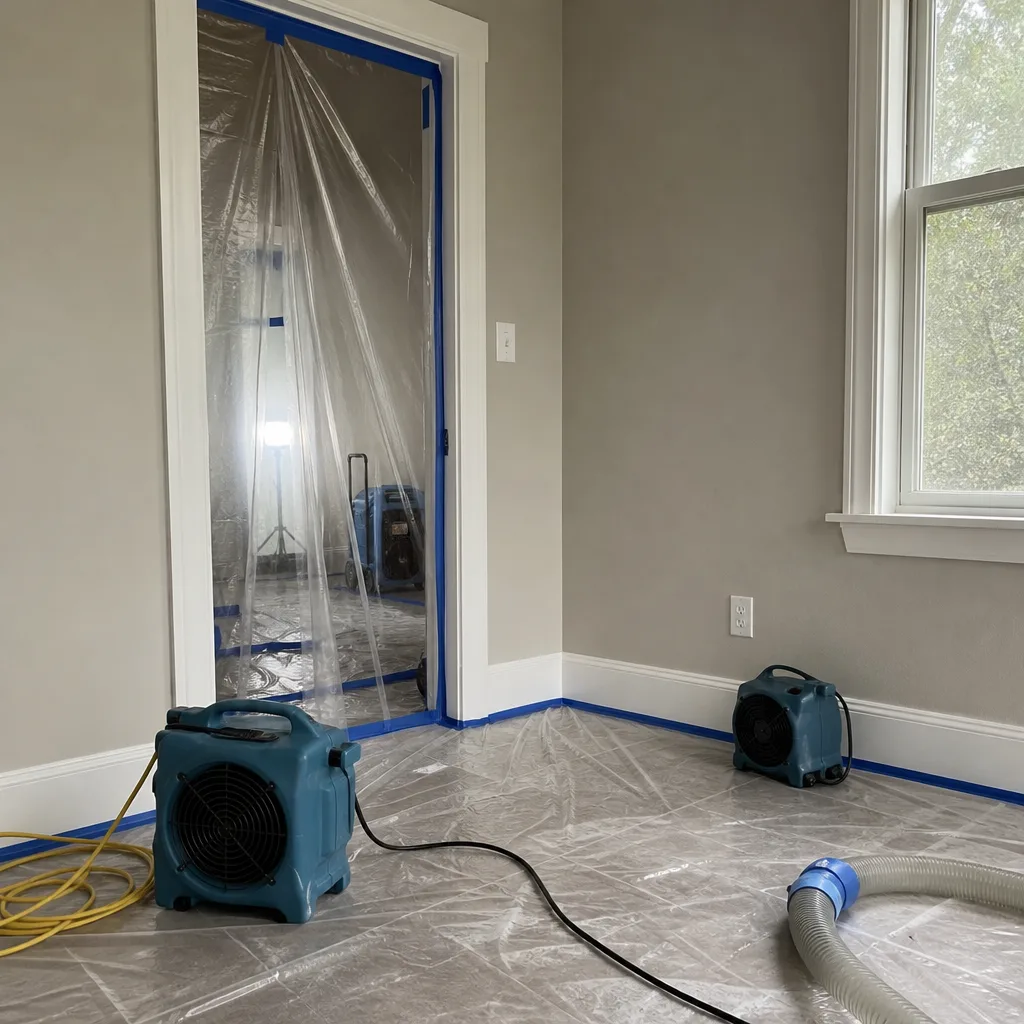 After
After